— A field manual in four acts —

Run the desk, not the noise.

A working playbook for recruiters using Hamrr — every act is one stage of the workflow, every scene is a step you can run today.

— Prologue —
How Hamrr
started.

We started as AI consultants. We build agents for a living — workflow automation, LLM orchestration, the full stack. Every day we're shipping agentic systems for other people's businesses.

The problem was we didn't have our own.

The first idea was obvious: an agent that builds other agents. A meta-platform. We started scoping it and quickly realised everyone else was building the same thing. It was too broad, too horizontal, and the market was already crowded with well-funded players racing to the same generic layer.

So we made a decision. Pick one industry. Go deep. Understand the workflows, the language, the pain, the money. Build something so specific to that vertical that a horizontal tool could never replicate it. Being close to the industry is the only way to prove you're adding real value — you can't agentify what you don't understand.

The answer was in the inbox
But which industry?
— We didn't have to look far. The answer had been sitting in our inboxes the entire time.

Recruiters. As consultants, we talk to recruiters every single day. They contact us. We contact them. We sit in their pipelines. We get their follow-up emails, their screening calls, their "just checking in" messages. We've been candidates in their systems for years.

And once we started paying attention, we noticed something: they all do the same thing. The same intake questions. The same follow-up cadence. The same Monday pipeline review. The same Tuesday chase to the hiring manager who's gone silent. The same Friday scramble to update the ATS before the weekend.

— Every recruiter we spoke to described the same five problems —
  1. 01Briefs come in messy and incomplete.
  2. 02Screening is manual and repetitive.
  3. 03The pipeline goes dark when nobody chases.
  4. 04Outreach gets no replies because it's sent on the wrong channel.
  5. 05Compliance is an afterthought until something breaks.

The process is standardised. The tools aren't.

We'd been gathering market research on recruitment without knowing it. Every time a recruiter logged us in their ATS, every time they sent us a templated InMail, every time they asked "are you still available?" — we were watching the workflow from the inside.

And then something clicked.

The meta-agent work wasn't wasted. The orchestration layer we'd been building — the router that decides which sub-agent handles a task, the planner that breaks a goal into steps, the state machine that tracks where a workflow is — that was exactly what a recruiting desk needed.

A recruiter's day isn't one job. It's five jobs happening simultaneously. A message comes in and it could be a new brief from a client, a candidate asking about interview times, a hiring manager finally replying with feedback, or a dormant candidate resurfacing. The recruiter has to mentally route each one to the right context, switch modes, and act.

That's an orchestration problem.

So we took the meta-agent architecture and pointed it at a recruiting desk. One router at the centre that reads every incoming message and decides: is this Intake? Screening? Pipeline? Outreach? Compliance? Each function became its own agent with its own rules of engagement — how it reads context, what it's allowed to do, when it escalates back to the human.

The intake agent knows how to structure a brief. The screening agent knows how to score a CV against a role. The pipeline agent knows when a deal is stalling. The outreach agent knows which channel to use and what tone to strike. The compliance agent knows what needs to be logged and what needs to be deleted.

One message in. The router decides. The right agent acts. The recruiter approves.
That's the desk. That's Hamrr.

Act I

How to source.

The research. The workflow. The wall. The machine. The five functions.

Scene 01
INT. THE RESEARCH — MARCH, 2026

Five recruiters, two months

We didn't start with a product. We started with conversations. Five agency recruiters, in depth, over the first two months. Phone calls, video calls, coffees in London. Not sales calls — listening sessions. We asked one question over and over: where does your time actually go?

We didn't shadow them or watch them work. We didn't need to. Every recruiter we sat with described the exact same day. Not similar — identical. Unprompted, in different agencies, different verticals, different cities, they walked us through the same workflow in the same order with the same frustrations.

That's when we knew the process was standardised. The tools just hadn't caught up.

Scene 02
ENTER — THE WORKFLOW

The same loop, every desk

Every recruiter described the same cycle. A requisition lands — a new role from a client. Sometimes it's a clean brief, sometimes it's a phone call with half the details missing. Either way, the clock starts.

They take the brief and try to understand it. What does the client actually need? What's the salary? What's negotiable? Half the time they're guessing because the hiring manager gave them three bullet points and a deadline.

Then they publish. The role goes out across job boards — LinkedIn, Indeed, Reed, totaljobs — each one with its own login, its own format, its own posting flow. Copy-paste, adjust, publish, repeat.

Then the applications arrive. And this is where the day disappears.

Scene 03
ENTER — THE SCREENING WALL

291 applications. One pair of eyes.

Screening is the bottleneck nobody talks about because everybody accepts it. CVs come in. The recruiter reads them, one by one. Some are obvious no's. Some are obvious yes's. Most sit in the middle and require judgment — is this person's 3 years at Deloitte really equivalent to what the client means by "Big Four experience"?

Every recruiter we spoke to described this as the most draining part of the job. Not the hardest — the most draining. It's repetitive, high-stakes, and happens before the recruiter has done anything that feels like actual recruiting.

Scene 04
ENTER — THE ATS

The heart of the machine

And then they log it. Every CV reviewed, every phone screen completed, every stage change, every note — it all goes into the ATS. Applicant Tracking System.

The ATS kept appearing in every conversation. It was the one thing every recruiter mentioned without us asking. Bullhorn. Vincere. JobAdder. Recruit CRM. Different names, same role: the central nervous system of the agency.

We'd seen CRMs before in other industries — the concept wasn't foreign. But the ATS was different. It wasn't just a contact database. It was the system of record for every candidate, every role, every placement, every fee. The billing runs through it. The compliance lives in it. The pipeline is defined by it.

It became obvious: if we wanted to agentify recruitment, we needed to be inside the ATS. Not sitting next to it. Not reading exports from it. Inside it. Reading and writing, in real time.

That was the first real architectural decision. Everything else followed from it.

Scene 05
INT. THE WHITEBOARD — LATE APRIL

The five functions

After two months of listening, we pinned the workflow to the wall. Every recruiter's day — regardless of vertical, desk size, or ATS — breaks into five functions:

The five functions — napkin sketch
Intakethe brief arrives, gets structured, gets committed to the system.
Screeningcandidates are assessed, scored, compared, shortlisted.
Pipelinedeals move through stages, hiring managers are chased, feedback is captured.
Outreachmessages go to candidates, dormant profiles get reactivated, first contact is made.
Compliancedata stays clean, opt-outs are handled, records are audit-ready.

Five functions. Every desk. Every agency. Every day.

The question was no longer "what do we build?" It was "which of these five can an agent run?"

The answer, it turned out, was all of them.

Act II

How we built the desk.

Turn five functions into five agents. Wire the router. Inject the domain.

Scene 01
INT. THE ARCHITECTURE — MAY, 2026

The meta-agent wasn't wasted

The consulting work we'd been doing for months — building agent orchestrators for other companies — turned out to be the foundation. We'd already solved the hard problem: how does one system receive a message, decide what kind of task it is, and route it to the right specialist?

That's exactly what a recruiter's desk needs.

But there was a harder problem underneath it. One we kept running into on every agentic build we'd shipped.

Scene 02
ENTER — THE FUNDAMENTAL PROBLEM WITH AGENTS

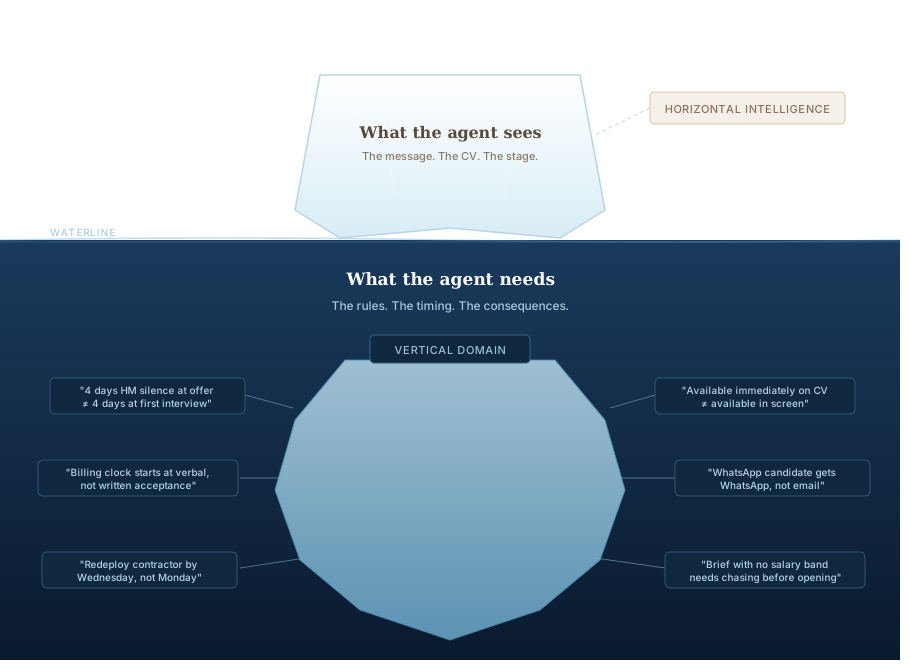
Horizontal intelligence. Vertical ignorance.

A general-purpose AI agent is horizontally capable. It can read, write, reason, summarise, extract, and draft. It can do all of these things reasonably well across almost any domain.

What it cannot do is predict the consequences of its actions.

Agents don't have a world model. They don't know that sending a candidate a follow-up message three hours after they just declined is a reputation risk. They don't know that moving a candidate to "offer stage" in Bullhorn before the client has verbally approved triggers a billing clock. They don't know that a contractor whose assignment ends on a Friday needs to be redeployed by the Wednesday before — not the Monday after.

These aren't intelligence failures. They're domain failures. The agent has no map of how the recruitment world actually works — the unwritten rules, the timing sensitivities, the sequence dependencies, the commercial consequences.

Left unsupervised, a horizontal agent in a vertical workflow doesn't just make mistakes. It makes expensive mistakes. Candidates ghosted at the wrong moment. Clients billed incorrectly. Compliance records left incomplete.

To automate with minimal supervision, the agent needs to know the domain before it acts.

The iceberg — what agents see vs. what domain knowledge requires
Scene 03
ENTER — THE RESEARCH, AGAIN

Why Act I wasn't just market research

The five conversations in Act I weren't just validation. They were the domain model.

Every recruiter told us the rules without knowing they were telling us the rules. The sequence of a requisition. How long you wait before chasing a hiring manager — long enough not to annoy them, short enough not to lose the deal. When a candidate going silent means disinterest versus anxiety about the process. What "available immediately" actually means on a CV versus in a phone screen. How a placement fee is calculated and when it crystallises.

None of this is in any API documentation. None of it is in the ATS schema. It lives in the heads of people who've placed hundreds of candidates across thousands of desks over years of agency work.

We extracted it from those five conversations. Then we encoded it.

Scene 04
ENTER — THE ROUTER

One message in, five agents listening — each with its own rules

We built a central router. Every input hits the router first — a WhatsApp message, an ATS event, a calendar signal, a contract end date. The router reads the context and decides: is this Intake? Screening? Pipeline? Outreach? Compliance?

Then it hands off to the right agent.

But each agent isn't just a general model with a job title. Each one carries the domain knowledge of its function — the rules, the timing logic, the commercial awareness, the edge cases.

The intake agent knows that a brief with no salary band is incomplete and needs a follow-up question before the role can be opened — not after. The screening agent knows that "8 years experience" on a CV for a role that asks for 5 is a signal, not a filter. The pipeline agent knows that 4 days of hiring manager silence at offer stage is a different risk than 4 days of silence at first interview stage. The outreach agent knows that a candidate who last responded on WhatsApp gets a WhatsApp message — not an email. The compliance agent knows which ATS fields are legally required and which ones create GDPR exposure if filled incorrectly.

These aren't prompts. They're policies. Domain knowledge injected as determinism into an otherwise probabilistic system.

Scene 05
ENTER — THE TWO-TIER DECISION

Cheap for extraction, smart for reasoning

Not every task needs the same brain. Pulling a candidate's name, email, and notice period from a message is pattern-matching. Deciding whether that candidate is a good fit for a role that needs "Big Four experience but startup mentality" is judgment.

So we split the models. A fast, cheap model handles extraction — parsing entities, reading ATS fields, categorising messages. A reasoning model handles the hard calls — scoring fit, drafting outreach, explaining risk.

Two tiers keeps the cost sustainable. An agency desk processes hundreds of messages a day. Running everything through a reasoning model burns through the margin we're trying to save the recruiter.

Scene 06
ENTER — WHATSAPP

Why not a web app

Every recruiter we spoke to in Act I had the same tell. When we asked "where do you actually talk to candidates?" the answer was never "in the ATS." It was WhatsApp. Or a personal phone call. Or a text.

The ATS is the system of record. WhatsApp is the system of action.

So we built Hamrr on WhatsApp. Not as a chatbot that messages candidates — as the surface the recruiter operates from. The recruiter types /pipeline and sees their desk. They type /risk Amelia Jackson and get a no-show score back in seconds. No browser tab. No login. No dashboard to learn. The tool lives where the recruiter already lives.

Scene 07
ENTER — THE GATE

YES, EDIT, or NO

The most important design decision wasn't technical. It was philosophical.

Agents cannot predict the consequences of their actions. We knew this from the problem in Scene 02. So the answer isn't to make a more capable agent. The answer is to keep a human at the decision boundary — informed by the agent's analysis, but never bypassed by it.

Every action Hamrr wants to take passes through a gate. The recruiter sees the proposed action and taps YES, EDIT, or NO. One tap.

The domain knowledge tells the agent what to do and when. The gate ensures the recruiter decides whether it happens. This is what minimal supervision actually means — not no supervision. Minimal. The recruiter spends two seconds on decisions that used to take two minutes, and never loses control of the outcome.

Scene 08
INT. THE DESK — LIVE

Five functions, one thread

The desk came alive the day all five agents ran in a single WhatsApp thread for the first time. A brief came in, the intake agent structured it, the screening agent scored three candidates against it, the outreach agent drafted messages, the pipeline agent tracked the stage changes, and the compliance agent logged everything to the ATS.

The recruiter approved six actions in four minutes. From their phone. On the tube.

The domain knowledge held. No billing clock triggered early. No candidate messaged at the wrong moment. No GDPR field filled incorrectly. The agent knew the rules. The recruiter kept control.

That was the moment it stopped being an experiment and became a product.

Act III

How to manage.

Pipeline that updates itself. Risk you see before it bites.

Scene 01

Coming soon

This act is being written.

Act IV

How to measure.

One desk score. A clear path to your target. Weekly review on rails.

Scene 01

Coming soon

This act is being written.

— End of manual —

Run a desk that runs itself.

Start free Back to home